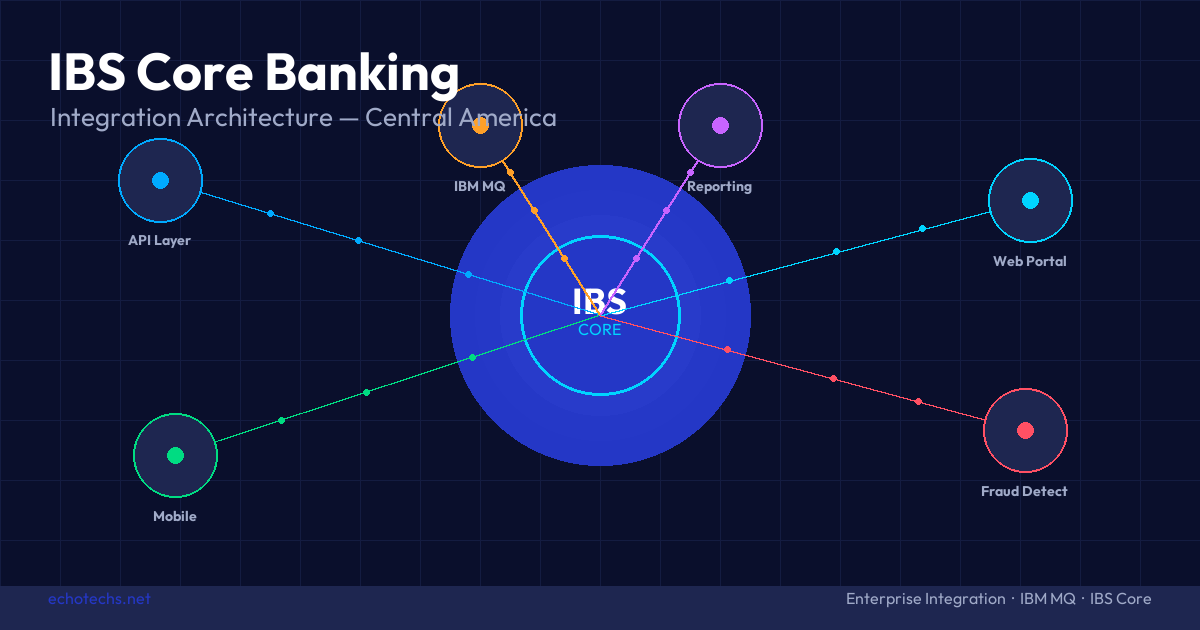
When you tap your phone to transfer money between accounts, check your balance at an ATM, or receive a salary deposit, a quiet but powerful engine processes every detail behind the scenes. In Central America, a significant portion of those transactions passes through IBS Core Banking — a platform designed for the demands of modern financial institutions that still operate on deeply entrenched IBM AS/400 (IBM i) infrastructure.
At EchoTechs, we specialize in connecting that legacy core to the digital world. This article breaks down what IBS Core Banking is, why it remains dominant across the region, and how the right integration strategy can unlock new capabilities without replacing existing infrastructure.
What Is IBS Core Banking?
IBS (International Banking System) Core Banking is a comprehensive financial management platform built to run on IBM i (formerly AS/400) servers. It handles the fundamental operations every bank depends on: account management, loan processing, deposit tracking, transaction routing, interest calculation, and regulatory reporting.
Its architecture is purpose-built for high reliability and data integrity — qualities that are non-negotiable in banking. The IBM i operating system, known for its stability and security record, provides the foundation that allows IBS to process millions of transactions with minimal downtime and predictable performance.
Why Central American Banks Still Rely on IBS
Replacing a core banking system is one of the most expensive and risky projects a financial institution can undertake. Migration projects routinely run into the tens of millions of dollars, take years to execute, and carry enormous operational risk. For most Central American banks, the question is not if they should modernize — it is how to do so without disrupting daily operations.
IBS Core Banking remains prevalent because it works. Decades of customization, compliance adaptations, and performance tuning have made each bank’s IBS implementation a highly specific, well-understood asset. The challenge is not the platform itself — it is connecting it to modern expectations: real-time APIs, mobile applications, reporting dashboards, and fraud detection systems.
The Integration Challenge: IBS Meets the Modern Stack
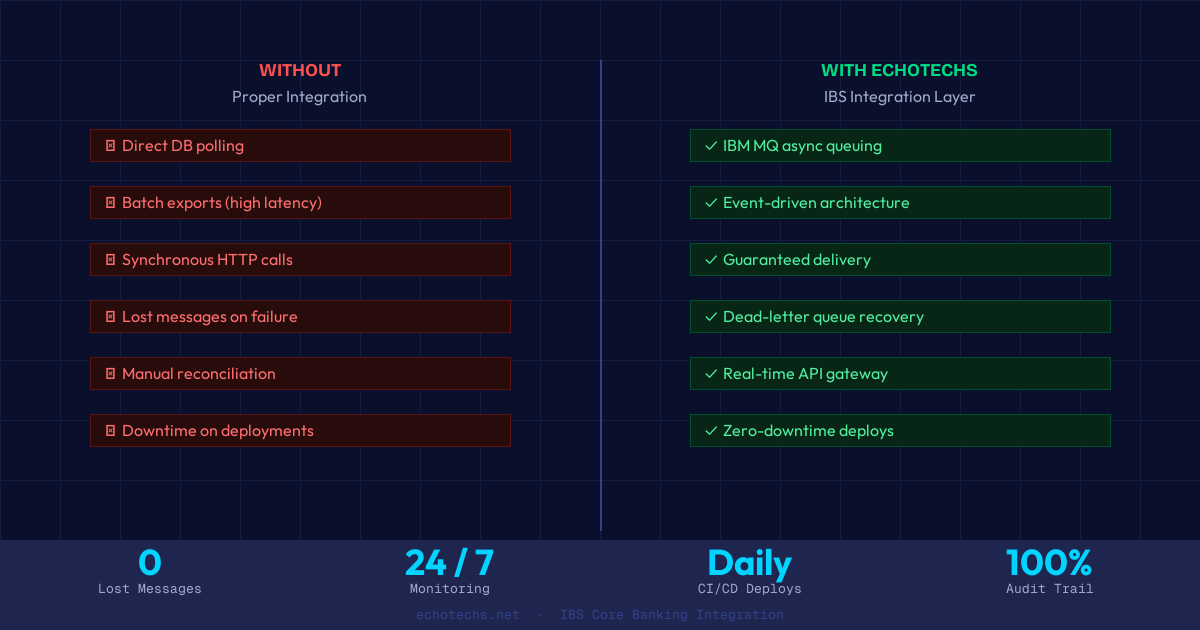
Traditional IBS installations were designed in an era before REST APIs and cloud-native architectures. Communication with external systems relied on batch file transfers, direct database calls, or proprietary messaging protocols. This creates a gap that most banks need to bridge urgently.
The most proven approach to bridging this gap is IBM MQ — a message queuing middleware that enables reliable, asynchronous communication between IBS and modern applications. IBM MQ sits between the core banking system and external services, normalizing message formats, ensuring delivery guarantees, and providing the resilience needed in financial-grade integrations.
How EchoTechs Integrates IBS Core Banking
EchoTechs has developed deep expertise in IBS integrations across Central American financial institutions. Our approach addresses the full spectrum of integration needs:
IBM MQ Message Bus
We design and implement IBM MQ topologies that connect IBS to API layers, mobile banking platforms, and third-party services. Messages are routed with proper error handling, retry logic, and dead-letter queue management to ensure no transaction is ever lost.
RESTful API Layer
We build a modern API layer that exposes IBS functionality through standard HTTP endpoints. This allows web portals, mobile applications, and partner integrations to interact with the core system using contemporary protocols — without modifying the IBS platform itself.
Real-Time Reporting
By tapping into IBS transaction streams via IBM MQ, we build reporting systems that provide near real-time visibility into portfolio performance, liquidity positions, and regulatory metrics. Business intelligence tools can connect to clean, structured data feeds instead of fragile direct database queries.
Mobile Banking Bridge
Customer-facing mobile applications require fast, reliable access to account data. We build the bridge between mobile backends and IBS, handling authentication, rate limiting, and caching to deliver smooth user experiences without overloading the core system.
What to Expect From an IBS Integration Project
Every IBS implementation is slightly different. Banks have customized their systems over years or decades, and integration work must account for those variations. A typical project with EchoTechs begins with a technical discovery phase where we map the specific IBS configuration, message formats, and available interfaces. From there, we design an integration architecture, develop and test the components, and deploy with a parallel-run period to validate behavior before full cutover.
Timeline and scope depend heavily on the number of systems being integrated and the complexity of existing customizations, but most projects deliver initial working integrations within the first few months.
The Future of IBS in Central America
IBS Core Banking is not going away. The investment in the platform, the stability it provides, and the cost of replacement all ensure its continued presence in Central American banking for the foreseeable future. What will change is the layer around it — the APIs, the mobile channels, the analytics, and the fraud detection systems that customers and regulators increasingly demand.
The banks that thrive will be those that treat IBS as a stable foundation and build thoughtfully on top of it. With the right integration partner, the IBM i core becomes an asset rather than a constraint.
If your institution is running IBS Core Banking and facing integration challenges, get in touch with our team. We have the technical depth to make your core system a platform for growth.