There is a conversation we have often with IT directors at banks across Central America. It usually starts like this:
“We know we need to modernize, but we cannot shut down the bank to do it.”
And they are right.
The AS400 is not just an old server nobody wants to touch. It is the operational core processing thousands of daily transactions, payroll, interbank payments and client history. Shutting it down is not an option. But leaving it exactly as it is for another decade is not one either.
So how do you move forward?
The mistake that kills most migration projects
When people hear “cloud migration,” they picture a project where you disconnect the AS400, move the data, install something new and flip it back on. In theory it sounds clean. In practice, that approach has destroyed budgets, paralyzed operations and left IT teams explaining why a six-month project turned into two years.
A proper migration does not work that way.
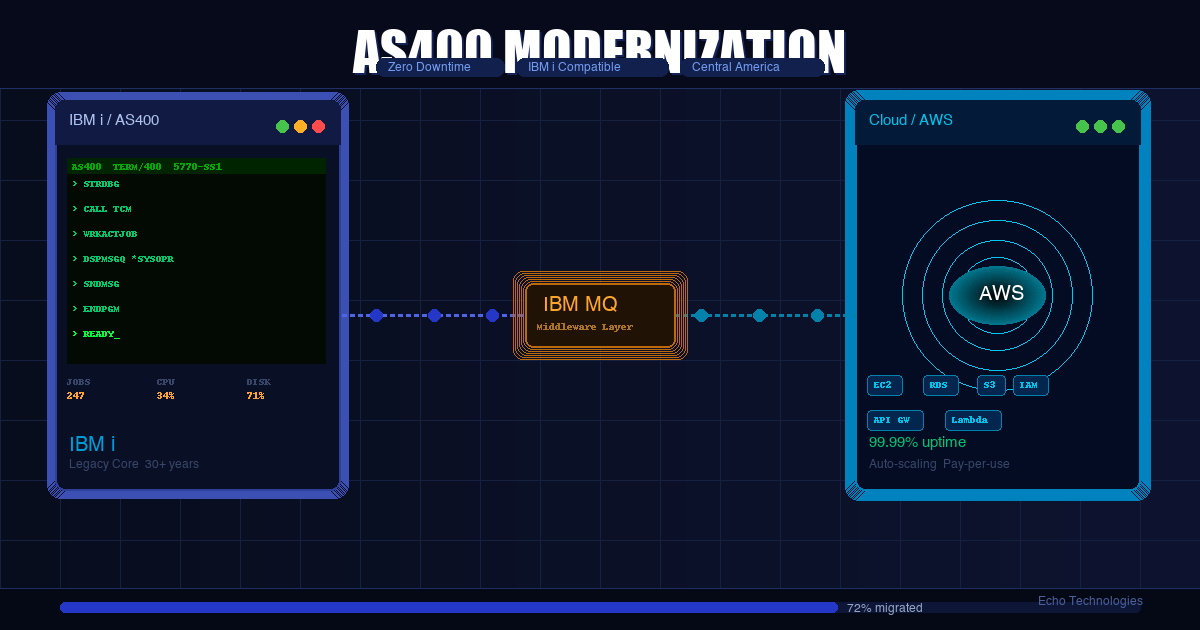
Migrating your AS400 to the cloud is a gradual process where the existing system keeps running while you build the modern infrastructure alongside it. It is not a replacement. It is an evolution.
The strategy that actually works: the bridge, not the jump
At Echo Technologies we have worked with financial institutions across Central America that run on AS400 and need to connect that system to the modern world: mobile apps, real-time dashboards, third-party APIs and digital channels.
We do not remove the AS400. We build a bridge to the cloud, with three layers:
1. IBM MQ as messaging middleware
The AS400 and the AWS systems communicate asynchronously and reliably. If one side goes down, the other keeps running. It is the same standard used by the largest banks in the world, and we implement it without disrupting your current operations.
2. REST API layer on top of the AS400
We expose your core data and functions through modern APIs. Your mobile app, your web portal and your reporting platform can all consume AS400 information without touching it directly.
3. New infrastructure on AWS
Modern services live in the cloud. The AS400 stays where it is, doing what it has always done, but now it has a layer connecting it to everything your bank needs today.
What does this mean in real money?
Banks that migrate infrastructure to AWS report average savings of 27% in operational infrastructure costs. But the number is not the most important part.
What changes is the structure of your spending.
You stop paying for physical hardware maintenance. You stop paying for on-premise server licenses that take up physical space and require specialized staff to keep running. On AWS, you pay for what you use. Quiet month, you pay less. Operations grow, you scale without buying new hardware.
For a financial institution in Central America, that is not just savings. It is agility.
The first step is not technical. It is strategic.
Before moving a single piece of data, the first step is understanding which part of your AS400 has the most urgency to modernize.
Some banks feel the pain in the digital channel. Others need reporting that does not take hours to generate. Others have a bottleneck in the integration with IBS core banking. Every case is different, and the right entry point depends on where your biggest problem is today.
At Echo Technologies we do that diagnosis before proposing any solution. Because this is not about selling a migration project. It is about solving what is actually holding your bank back.
Running an AS400 in production and thinking about the next step?
We have done this before, with real banks, with live systems in production. If you want a direct conversation about what this process would look like for your institution, we are available. No commitment, no 40-slide sales decks.
Just an honest conversation about your system and what can be done.
Sergio Erazo, COO of Echo Technologies