Every year, the same cycle: the IT budget goes up, the board asks questions, and the technology director goes back to justifying every server, every license, every support contract. What nobody is calculating correctly is the total cost of staying exactly where they are.
We have had this conversation many times with technology directors at banks across Central America. It is not a conversation about whether AWS is good or bad. It is a conversation about money: what it actually costs to maintain on-premise infrastructure, and what happens to that number when part of it moves to the cloud.
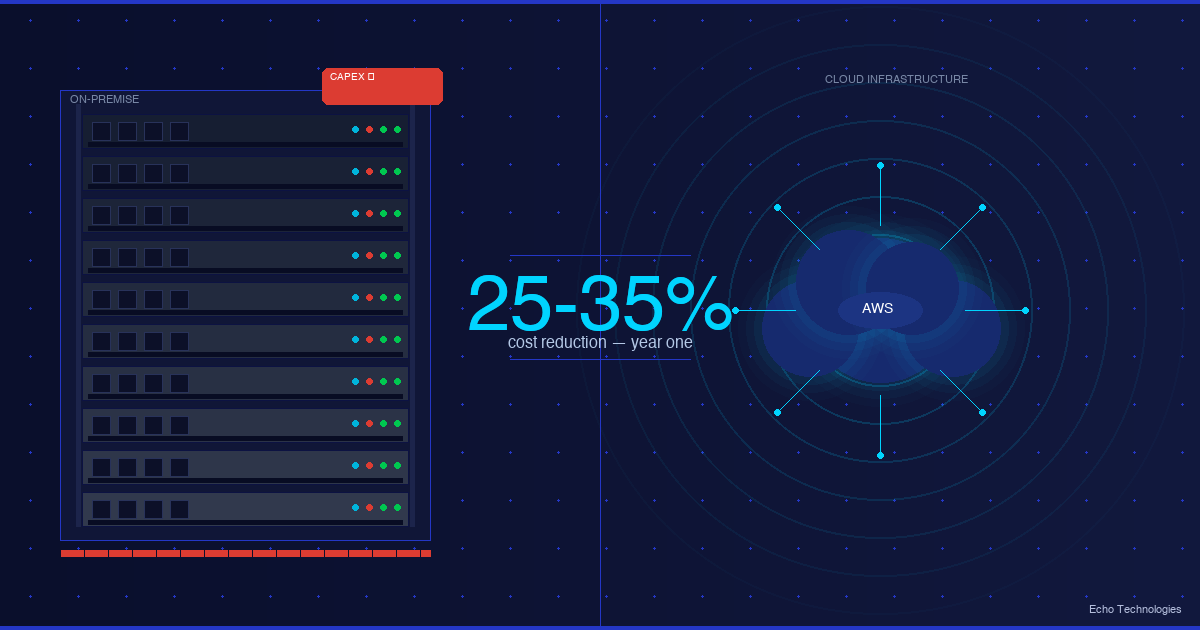
The numbers we see across the region are consistent. Banks that migrate non-critical services to AWS report reductions of between 25% and 35% in infrastructure operating costs in the first year. It is not magic. It is cost structure.
The problem nobody is measuring correctly
When a bank evaluates the cost of its on-premise infrastructure, it usually looks at hardware cost. That is a mistake.
The real cost has four layers that are rarely added together:
- Hardware and refresh cycles. Servers have a 3 to 5 year lifecycle. At the end of that cycle, the cost is not just buying new equipment. It is migrating, reconfiguring, testing, and re-certifying everything running on top of it.
- Fixed capacity licenses. You pay for maximum capacity, not for what you actually use. If your system uses 40% of capacity 80% of the time, the remaining 60% is money that leaves without doing anything.
- Operations personnel. Someone has to manage that hardware, apply patches, monitor availability, and respond when something breaks at 3 in the morning. That personnel cost does not appear on the infrastructure line, but it belongs there.
- Datacenter operating costs. Energy, cooling, physical space, colocation contracts. These are fixed costs that do not go down even if business goes down.
When you add those four layers together, the real number is significantly larger than what appears in the IT budget under the infrastructure line.
What changes with AWS
AWS does not eliminate all those costs at once. What it does is change the structure of how you pay for capacity.
With on-premise, you pay for what you might need. With AWS, you pay for what you use. That difference, in a mid-sized bank with variable loads throughout the day and month, represents between 20% and 35% in savings in the first year alone.
Beyond that, AWS eliminates three costs that are normally invisible in the budget:
- Hardware refresh. AWS updates its infrastructure at no additional cost to you. There is no refresh cycle to budget for and no migration project every four years.
- High availability and disaster recovery. On-premise, redundancy is a separate project with its own budget. On AWS, it is part of the base architecture.
- Operations team time. When AWS manages the hardware and availability, your IT team stops fighting fires and starts building.
“But our AS400 cannot go to the cloud”
That is the first thing we hear. And it is true: we are not talking about moving the AS400 to AWS. That does not make technical or economic sense for most banks in the region.
What does make sense is moving the services that surround the AS400: digital channels, real-time reporting, third-party APIs, mobile banking modules, authentication services. Those consume expensive on-premise infrastructure and work perfectly on AWS.
The AS400 stays where it is, doing what it has always done. IBM MQ acts as the bridge between the core and the cloud services. Transactions flow in both directions without interruption. What changes is who pays for which part of the infrastructure, and how.
The three-year calculation few people do
Most cost evaluations look at year one. The problem is that year one of AWS includes migration costs that distort the number. The honest analysis is done over three years.
Over a three-year horizon, a mid-sized bank in Central America typically sees:
- Elimination of one or two hardware refresh cycles
- A 20% to 30% reduction in capacity licensing costs
- A 30% to 40% reduction in operations team time, redirected toward value-building projects
- Functional disaster recovery without a separate project budget
When those numbers are added together, partial migration to AWS is not a cost. It is an investment with measurable return.
Where to start
The first step is not technical. It is identifying which part of your current infrastructure absorbs the most cost with the least return.
In most of the banks we have worked with across El Salvador, Guatemala, and Panama, that analysis reveals that between 30% and 50% of on-premise infrastructure could be migrated to AWS without touching the banking core, without interrupting operations, and with a transition period of three to six months.
At Echo Technologies, we do that diagnosis before proposing any solution. There is no point talking about AWS until we know exactly which costs we are targeting and which services are real migration candidates.
If you want to have that conversation, with real numbers about your specific architecture, we are available.
No sales proposal. Just the analysis of your specific case.
Luis Rugamas, CEO of Echo Technologies