When a company in Central America decides to move toward digitalization, the first question is rarely “can you help us?” It is almost always “what exactly does that service include?” That is a legitimate question. Hiring a digital transformation consulting service is an investment of time, money, and internal political capital, and no one wants to commit to a process they do not fully understand.
This guide answers that question in detail. It explains each component of a well-structured digital transformation consulting service and shows how that process works in concrete sectors: banking, retail, and industrial.
What Is Digital Transformation Consulting?
Digital transformation consulting is not about installing new software. It is a structured process that analyzes how an organization operates today, defines where it wants to go, and builds the technical and human path to get there.
The most common mistake is purchasing technology before understanding the problem. A serious consultancy invests time in the diagnostic phase before proposing any solution. The order matters.
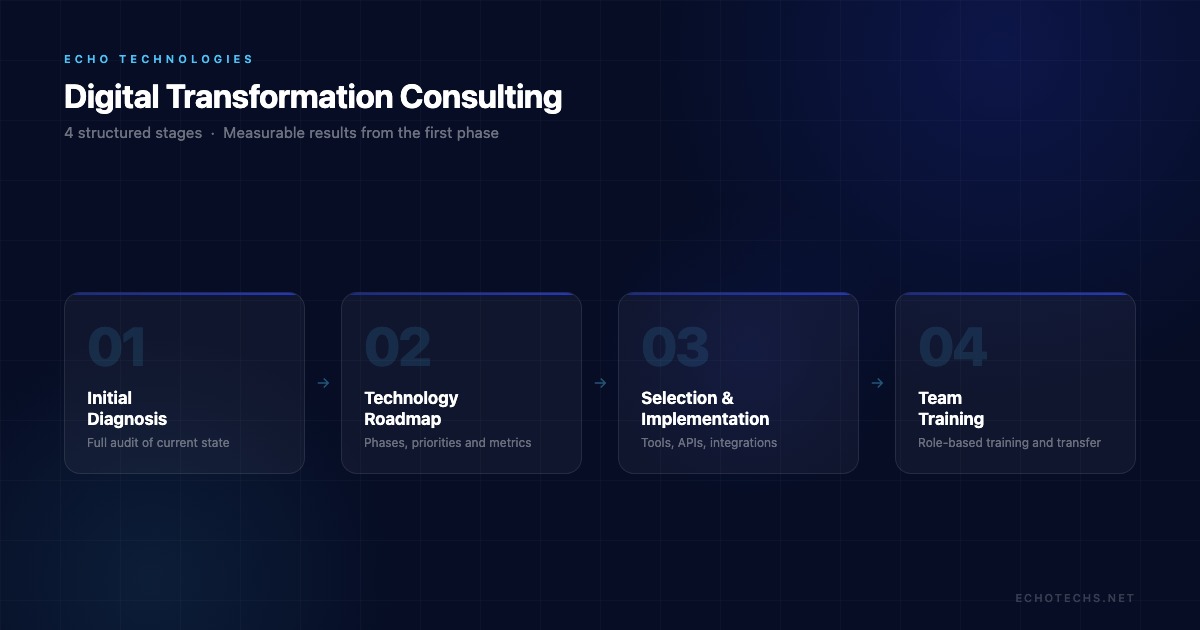
The Four Components of a Digital Transformation Consulting Service
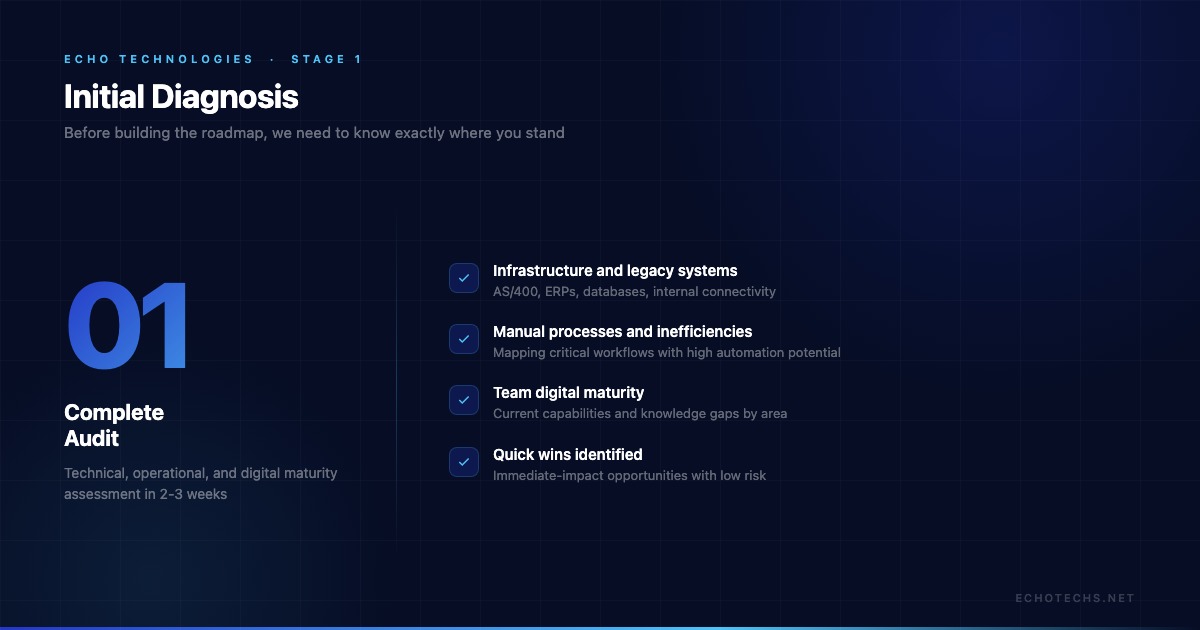
1. Initial Diagnosis
The starting point is always the current reality. Not the reality the company thinks it has, but the one that actually exists in its systems, processes, and the teams that operate them.
- Mapping of key operational processes: how information flows, where it stops, and why
- Audit of existing systems: what technology is in use, what versions, what technical debt has accumulated
- Technology gap analysis: the distance between what current technology supports and what the business needs
- Interviews with operational teams: the people who execute processes understand problems with more precision than management
- Risk analysis: failure points, critical dependencies, exposure to data loss
This diagnostic is not a formality at the start of a project. It is the foundation for every decision that follows. An incomplete diagnostic produces the wrong roadmap.
2. Technology Roadmap
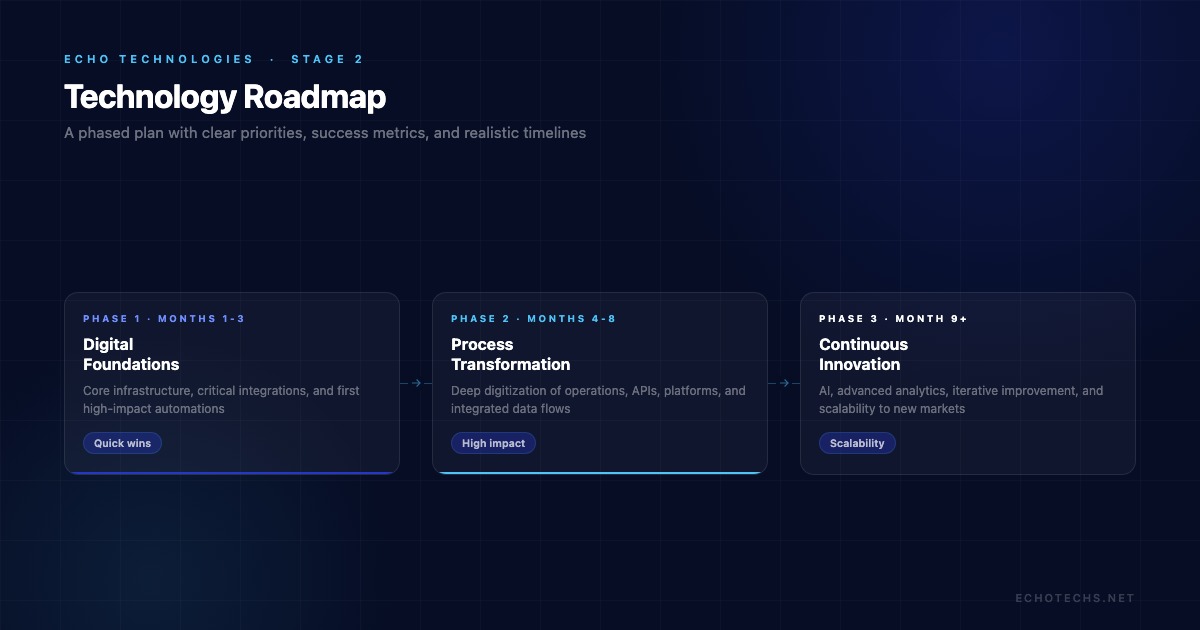
With a complete diagnostic, the next step is defining the project map: what gets done first, why it is prioritized that way, and how progress is measured at each stage.
- Prioritization by impact and feasibility: which changes generate the most value with the least risk in the short term
- Phase definition with specific objectives, deliverables, and concrete dates
- Technology evaluation using objective criteria, not brand preferences
- Integration plan that defines how new systems coexist with existing ones without interrupting operations
- Measurable success indicators for each phase
In the banking sector, for example, a 12-month roadmap might have a first phase of 90 days focused exclusively on digitalizing the credit origination process before touching any other system.
3. Tool Selection and Implementation
This is the phase most commonly associated with “digital transformation,” but without the two preceding phases, it does not work. Tool selection does not start with a vendor catalog. It starts with the criteria defined during the diagnostic phase.
- Vendor evaluation using criteria defined during the diagnostic
- Proof-of-concept testing before long-term commitments
- Integration architecture definition: APIs, middleware, connectors
- Staged implementation rather than a single massive change all at once
- User testing and operational validation at each phase before advancing
4. Team Training
The most advanced technology fails if teams do not know how to use it or if they perceive it as a threat. Training is not a closing module. It is an integral part of the process from the beginning.
- Role-based training: each team learns what it needs for its specific function, not a generic course for everyone
- Operational documentation that teams can reference after the project ends
- Support during the post-launch stabilization period
- Knowledge transfer so the internal team can maintain and evolve the system going forward
How It Works in Practice: The Banco Integral Case
Banco Integral needed to digitalize its credit origination process without replacing the core banking system that had been in operation for years. Replacing it would have taken years and represented significant operational risk.
Echo Technologies designed an integration architecture that connected the existing core banking system with a digital credit platform, using APIs and connectors that allowed both systems to operate in parallel. The result was a platform capable of managing credit applications in a fully digital workflow, with no need to migrate the base system.
The process followed exactly the four stages described: a diagnostic of the current state of the core system, a roadmap that prioritized credit digitalization as the first phase, tool selection based on compatibility criteria with the existing system, and team training before launch.
For full project details: Banco Integral – Digital Credit Platform Case Study.
How This Applies in Other Sectors
The methodology is the same. The problems and the tools change.
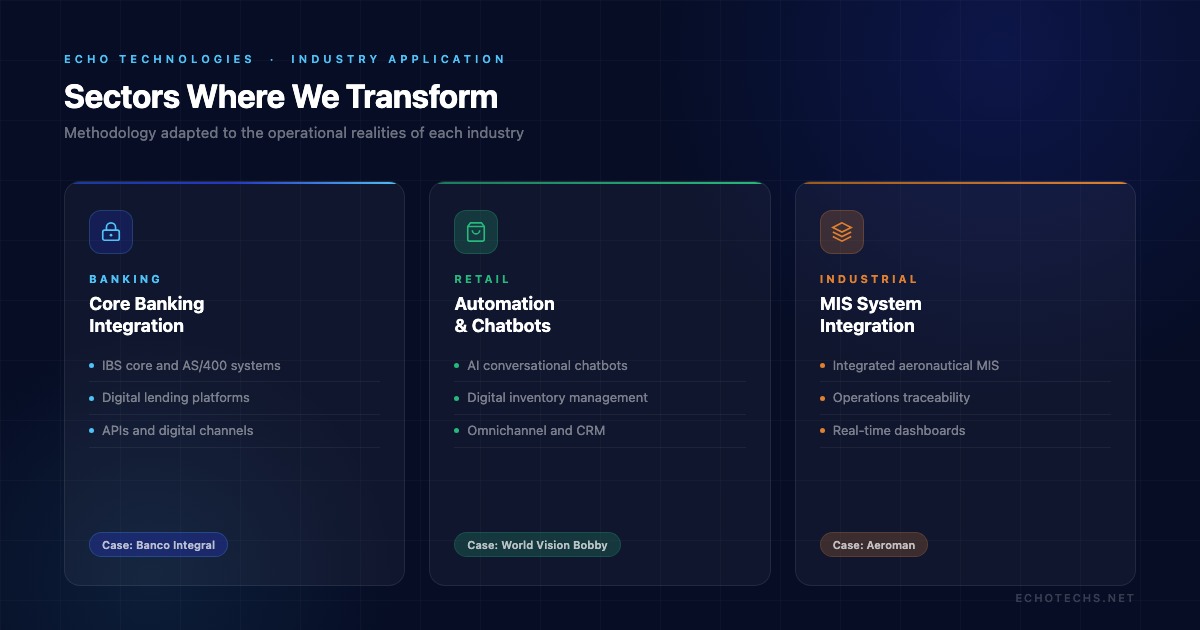
Retail and Social Sector: Automation Facing the Customer
World Vision needed to serve thousands of beneficiaries with a limited support team. The answer was not hiring more staff. It was automating attention at the repetitive contact points.
Echo Technologies developed Bobby, a chatbot that allows World Vision to scale its service capacity without growing the dedicated team. The process started with a diagnostic of communication flows with beneficiaries, not with a chatbot proposal.
Full case study: World Vision – Bobby Chatbot.
Industrial and Aviation Sector: Integration Without Disruption
Aeroman operates a specialized MIS (Management Information System) for aeronautical maintenance. The problem was not the system itself. It was that its data lived in silos separated from the rest of the internal operations.
Echo Technologies integrated the MIS with the internal operational tools, connecting information that previously required manual work to consolidate. The result was not a new system. It was real-time visibility over data that already existed.
Full case study: Aeroman – Aeronautical MIS Integration.
Measurable Results from the First Phase
A well-structured digital transformation consulting service delivers measurable results before the project ends. The specific indicators are defined during the initial diagnostic, but the most common ones include:
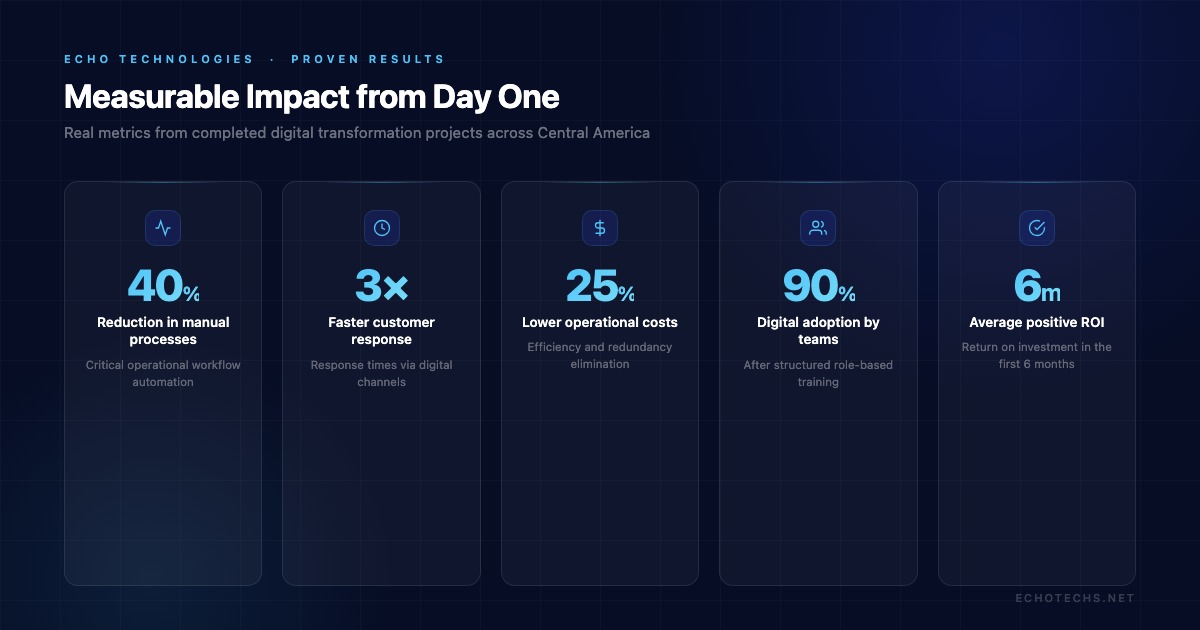
- Reduction in processing times for key operational processes
- Lower error rate in transactions or records that were previously manual
- Expanded processing capacity without proportional increases in staff
- Shorter response times for clients and internal teams
- Full traceability over processes that were previously opaque
The key is that these indicators are agreed upon before the project starts, not at the end. If a consultancy cannot commit to concrete metrics from the diagnostic phase, that is a warning sign.
The First Step
Before talking about budgets or tools, we need to understand where you are today. The initial diagnostic is the first deliverable in any project with Echo Technologies, and it determines whether everything that follows makes sense for your organization.
Luis Rugamas, CEO of Echo Technologies